Exploring Suzanne’s Petal Patch Digital Papers
In the world of digital design and paper crafting, finding a cohesive collection that balances artistic flair with practical versatility is a genuine win. Suzanne’s Petal Patch Digital Papers represents exactly that kind of find—a thoughtfully curated set that understands the modern creative's need for both beauty and function. This collection brings together bold floral illustrations and soft geometric textures in a palette that feels both timeless and contemporary, offering a fresh take on romantic design aesthetics without veering into sentimentality.
The Visual Character: Where Florals Meet Geometry
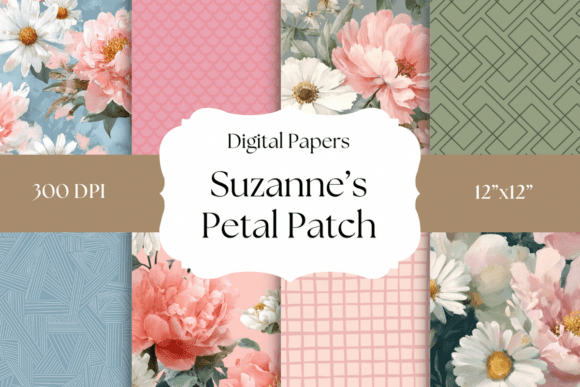
What makes Suzanne’s Petal Patch stand out is its deliberate contrast between organic and structured elements. The painterly blooms have that hand-crafted quality—soft edges, subtle color variations, and a sense of movement that digital art sometimes lacks. These aren't sterile, perfectly symmetrical flowers; they have personality. Yet they're balanced by clean geometric patterns—dots, lines, grids, and abstract shapes—that provide visual breathing room and make the collection incredibly usable.
The color palette deserves attention too. Those muted pinks, dusty blues, sage greens, and creamy whites create a sophisticated mood that avoids the pitfalls of being either too juvenile or too dated. This is a palette that works across seasons and contexts. The dusty blue grounds the sweetness of the pinks, while the sage green adds an earthy, natural element. Creamy whites serve as the neutral foundation that ties everything together. It's a palette that feels curated rather than random, which matters when you're building visual consistency across multiple design assets.
Real-World Applications for Creative Professionals
Let's talk about where this collection actually earns its place in a designer's toolkit. For junk journal creators, these papers solve a persistent problem: finding backgrounds that are interesting enough to stand on their own but not so busy that they compete with layered elements. The geometric patterns in Suzanne’s Petal Patch work beautifully as base layers, while the floral sheets become focal points or accent elements. You can mix and match without the collection feeling disjointed—a quality that separates truly useful design assets from decorative novelties.
Scrapbookers and card makers will find similar value. The 12x12 inch format at 300 DPI means you're working with print-ready files that won't pixelate or lose detail when you scale them for different projects. Whether you're creating a full-page scrapbook layout or trimming down to A2 card panels, the resolution holds up. This matters more than people realize—nothing undermines a handmade card faster than fuzzy, low-quality printed elements.
For those working in digital spaces, consider how these papers translate to social media graphics, blog post backgrounds, or website hero images. The muted palette photographs well and doesn't create the visual noise that makes overlaid text hard to read. A dusty blue geometric pattern from Suzanne’s Petal Patch, for instance, could serve as an elegant Instagram story background where white or dark text remains legible without additional overlays or shadows.
Building Brand Identity with Intentional Pattern Choices
Here's where thinking like a brand strategist becomes valuable. Patterns and textures communicate personality just as powerfully as typography or color choices. If you're a small business owner in the wellness, lifestyle, floral, or artisan space, incorporating elements from Suzanne’s Petal Patch into your visual identity can reinforce specific brand attributes. The painterly quality suggests authenticity and craftsmanship. The geometric coordination implies intentionality and professionalism. Together, they create a visual language that feels both approachable and polished.
Think about packaging design for a small-batch candle company, a botanical skincare line, or a boutique stationery brand. The floral elements could become box interior prints, tissue paper patterns, or thank-you card backgrounds. The geometric patterns work for hang tags, business cards, or product labels where you need texture without distraction. This kind of coordinated visual system—where multiple touchpoints share the same design DNA—is what separates brands that feel cohesive from those that feel pieced together.
Practical Considerations for Project Integration
Before committing any design asset to a project, it's worth doing a quick evaluation. With Suzanne’s Petal Patch, consider the dominant mood you're trying to create. This collection leans romantic and soft, which aligns beautifully with spring and summer themes, wedding stationery, feminine branding, or vintage-inspired editorial work. If your project demands stark minimalism or aggressive, high-contrast energy, this probably isn't the right fit—and that's fine. Knowing when not to use something is just as valuable as knowing when to use it.
Font pairing is another practical consideration. When using these papers as backgrounds for typographic elements, test how different typefaces interact with the patterns. A clean sans serif font tends to work well against the busier floral patterns, maintaining readability while creating visual contrast. For the simpler geometric papers, you have more flexibility—a script font or handwritten font might work beautifully without getting lost. The key is testing combinations at actual size before finalizing anything.
The eight-paper set gives you enough variety to create visual hierarchy across multi-page projects without feeling repetitive. Use the boldest florals sparingly—as accent pieces or feature pages—while the coordinating textures handle the heavy lifting as backgrounds and supporting elements. This strategic distribution of visual weight is what makes a junk journal feel intentional rather than chaotic, or a set of marketing materials feel unified rather than monotonous.
Understanding Licensing and Commercial Use
For designers and entrepreneurs planning to use Suzanne’s Petal Patch in commercial projects, reviewing the licensing terms is essential before purchasing. Most digital paper collections come with specific guidelines about how files can be used—whether they're permitted in products for sale, how many physical or digital end products can be created, and whether attribution is required. Understanding these terms upfront prevents complications later, especially if you're creating printable products, selling handmade goods, or incorporating the patterns into client work.
The JPEG format included in this set offers broad compatibility across design software, from Adobe Photoshop and Illustrator to Canva, Procreate, and even basic photo editors. This accessibility matters for creators who work across different platforms or who want to share files with collaborators who might not have specialized design software. High-resolution files at 300 DPI also ensure that whether you're printing at home, using a professional print service, or outputting to a commercial printer, the quality remains consistent.
Suzanne’s Petal Patch Digital Papers ultimately represents a practical investment for anyone whose creative work involves layering, texture, and coordinated visual elements. It's not trying to be everything to everyone—it knows exactly what it is and executes that vision with quality and consistency. For the crafter building a seasonal collection, the designer developing brand collateral, or the entrepreneur creating packaging that tells a story, this set provides a reliable foundation to build upon. The real value isn't just in the individual papers but in how they work together as a system—and that's where thoughtful curation makes all the difference.